The DVLA Has Just Banned These Shocking ‘76’ Number Plates
15 Sep 2026The new 76 registration plates are now on UK roads, but hundreds of combinations will never be issued. Here’s why the DVLA has withheld them and some of the most unusual examples from the latest list.
There is something strangely entertaining about the UK’s number plate system.
Every six months, millions of new registration combinations become available as the latest plate change arrives. Most pass through the system without anyone giving them a second thought.
But not every combination makes it onto a car.
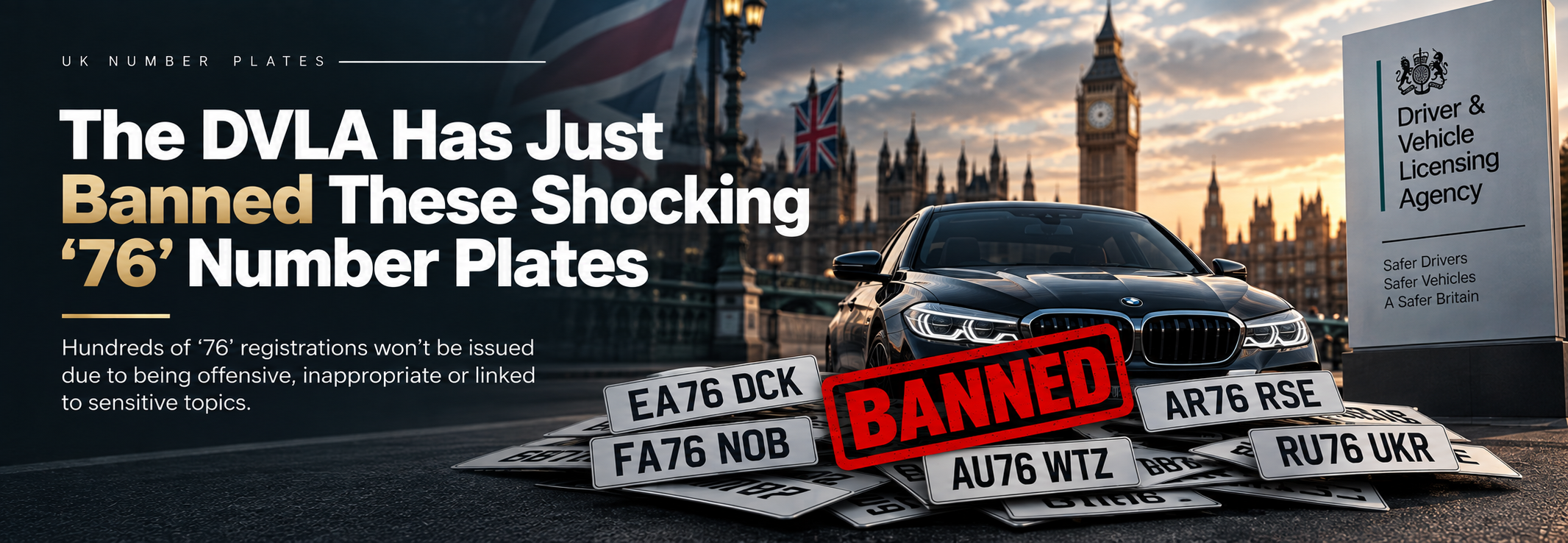
Before the new 76 registration series was released in September 2026, the Driver and Vehicle Licensing Agency, better known as the DVLA, reviewed the available combinations and removed hundreds that could be considered offensive, inappropriate, embarrassing or potentially sensitive.
This isn’t a new process.
The DVLA carries out a review ahead of each March and September plate change. However, every new registration series creates its own collection of combinations that can accidentally form words, phrases or references when the letters and numbers are read together.
And the latest 76 series has produced some particularly unfortunate combinations.
A total of 511 registration combinations have been withheld from the 76 series, meaning they will not be issued through the normal registration process.
Some are fairly easy to understand.
Others require a little imagination.
And a few become considerably more obvious when you read the numbers as letter
Why Does the DVLA Ban Number Plates?
Strictly speaking, these registrations are generally described as being withheld, rather than “banned”.
The DVLA reviews registration combinations and removes those that could cause offence, embarrassment or simply be considered inappropriate.
The process isn’t limited to rude words.
The agency considers a wide range of potentially problematic combinations, including references to:
- Offensive or obscene language
- Sexual references
- Drugs and criminal activity
- Racist or discriminatory language
- Religious sensitivities
- Political references
- Terrorism
- War and international conflicts
- Historical events likely to cause serious offence
- Combinations that could be interpreted as threatening or inflammatory
The idea is fairly straightforward.
A registration number is displayed prominently on a vehicle, potentially for years, so the DVLA doesn’t want combinations that could reasonably cause offence or create unwanted attention.
And because the UK registration system combines letters and numbers in a specific format, some combinations can create words that weren’t necessarily obvious when the registration was generated.
The Problem With the Number 76
The 76 series has created an interesting problem because the numbers can sometimes be interpreted as letters.
The 7, in particular, can be visually interpreted as a T in certain contexts.
That means a registration which initially looks completely harmless can take on a very different meaning when the characters are read creatively.
One example from the withheld list is:
EA76 DCK
Read normally, it looks like a fairly ordinary registration.
Interpret the “7” differently, however, and the meaning becomes considerably less innocent.
Another example is:
FA76 NOB
Again, the combination of letters and numbers creates a word when the registration is interpreted differently.
Then there are combinations where the letters themselves do most of the work.
AR76 RSE, for example, can be interpreted as an offensive term when the registration is read as a whole.
This is one of the reasons the DVLA has to look beyond individual letters and numbers.
It isn’t simply a case of checking whether a registration contains an obviously offensive three-letter combination.
The entire sequence has to be considered.
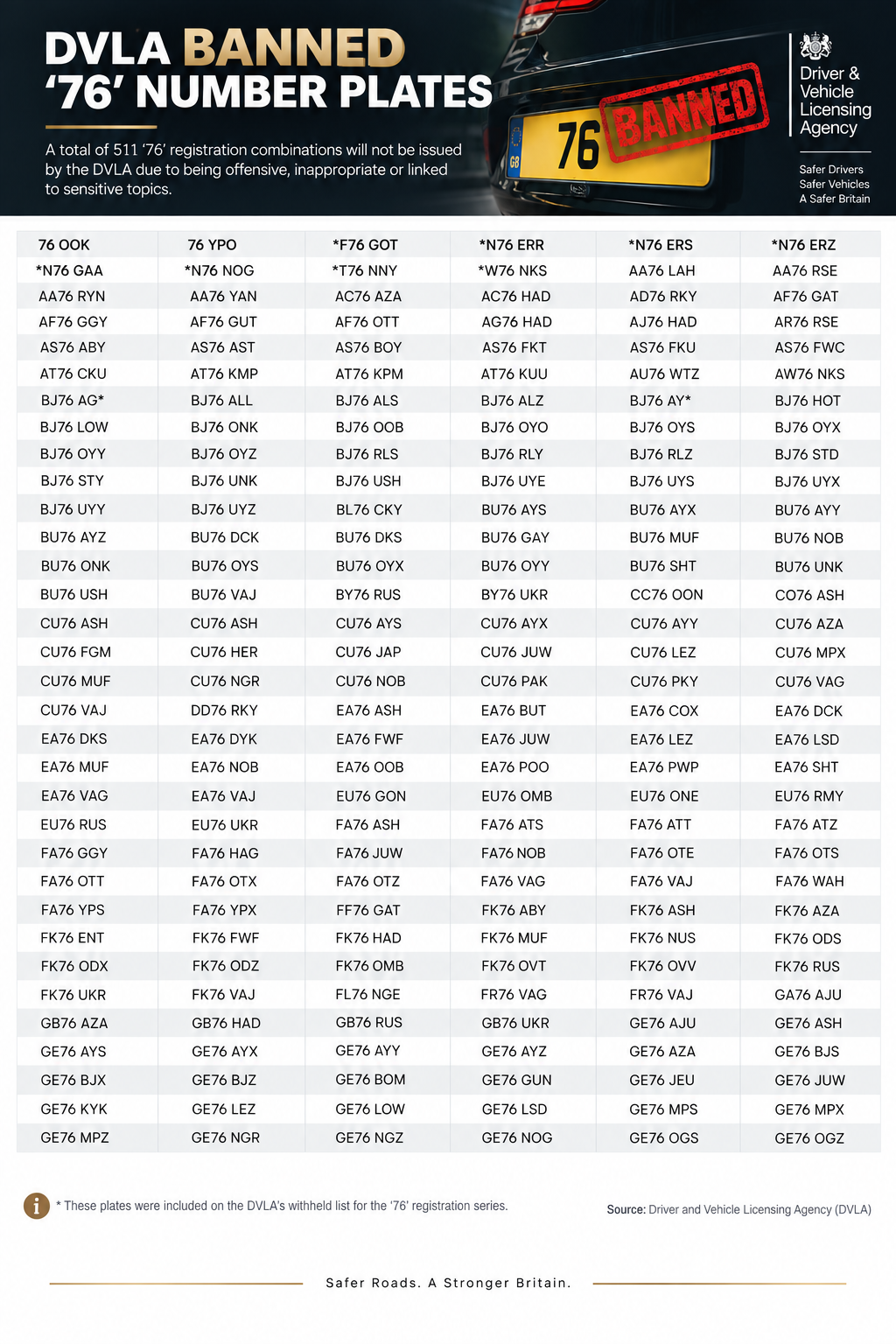
The 76 registration combinations withheld from issue by the DVLA.
511 Registrations Have Been Withheld
The scale of the latest list is perhaps the most interesting part.
For the March 2026 plate change, the DVLA withheld 436 combinations from the 26 series.
For September’s 76 series, that number has increased to 511.
That’s a significant rise.
Of course, this doesn’t mean that there are suddenly 511 offensive phrases hiding within the new registration system.
Some combinations are withheld because of very specific interpretations, while others relate to sensitive subjects or combinations that could reasonably be considered inappropriate.
The majority of the 76 registrations remain perfectly acceptable and are being issued as normal.
But the withheld list gives us an interesting look at the kind of things the DVLA has to consider when releasing a new registration series.
Some of the 76 Plates Are Linked to Global Conflicts
Not all the withheld registrations are about rude words.
Some relate to current or recent geopolitical events and sensitive subjects.
Among the combinations shown in the latest list are:
AU76 WTZ
GB76 AZA
JE76 HAD
RU76 UKR
YE76 MEN
These combinations can be interpreted as references to locations, conflicts or sensitive international subjects.
For example, combinations referring to Ukraine, Gaza and Yemen are particularly sensitive because of ongoing and recent conflicts associated with those regions.
The DVLA’s approach therefore extends beyond simply preventing offensive language.
It also considers whether a registration could be interpreted as making an inappropriate reference to a serious or sensitive subject.
Why Does This Happen Every Six Months?
The UK registration system introduces new age identifiers twice a year.
The March plate uses the year’s final two digits.
The September plate uses the second half of the registration format.
For example:
26 = March to August 2026
76 = September 2026 to February 2027
That means the DVLA has to review a new set of combinations twice every year.
The process has become something of a tradition in the automotive world.
Every plate change brings a new list of registrations that have been withheld, and motoring enthusiasts inevitably start looking through the list to see which combinations didn’t make the cut.
The Numbers Don’t Always Mean What You Think
One of the fascinating things about UK registrations is that people naturally try to make words out of them.
That’s also why certain combinations can become problematic.
For example, people commonly interpret:
0 as O
1 as I
2 as Z
3 as E
4 as A
5 as S
6 as G
7 as T
8 as B
9 as G or P
These aren’t official replacements.
They’re simply ways people may visually interpret characters.
The DVLA therefore has to consider how a registration could realistically be read rather than relying exclusively on the literal characters printed on the plate.
That can turn a seemingly harmless combination into something much less appropriate.
Not All Offensive Plates Are Obvious
Some registrations are immediately understandable.
Others require you to say them out loud.
And some depend on looking at the characters in a particular way.
That’s what makes these lists so interesting.
A combination might look completely innocent until someone spots a different way of reading it.
This is particularly relevant for personalised registration enthusiasts.
People deliberately spend money looking for registrations that resemble names, words or phrases.
The same creativity that makes a personalised registration desirable can also make certain combinations unsuitable for general issue.
Personalised Plates Are a Different Story
It’s important to distinguish between the standard registrations being released for the 76 series and personalised registration numbers.
The DVLA has a separate system for buying and transferring personalised registrations.
However, the same basic principle applies.
A registration that is considered unsuitable for issue isn’t simply made available because someone is willing to pay for it.
The DVLA can withhold combinations that it considers offensive or inappropriate.
This is why some seemingly desirable combinations never appear on the market.
For collectors and personalised plate enthusiasts, this can make certain combinations particularly interesting.
Sometimes, the registration you can’t buy is the one everyone ends up talking about.
What About Number Plates That Are Already on Cars?
The latest 76 list relates to registrations being withheld from issue.
That doesn’t mean every existing plate that happens to resemble a word or phrase is suddenly being removed from the road.
There are already millions of registrations in circulation, including some unusual combinations that have been around for years.
The DVLA’s screening process is primarily concerned with preventing problematic combinations from being newly issued.
So if you’re driving around with a completely legitimate registration that happens to form an unfortunate word when someone gets creative with it, the arrival of the 76 plate doesn’t automatically mean you need to change it.
Can You Make Your Own Number Plate?
This is where things become important.
You can’t simply rearrange characters, alter the spacing or use a different font to make your registration look like something else.
UK number plates have strict requirements regarding their construction and display.
A legal plate must comply with rules covering its:
- Character font
- Character height
- Character width
- Stroke thickness
- Character spacing
- Margins
- Background
- Reflectivity
- Markings
For modern plates, the standard Charles Wright 2001 font is used.
The front plate must have a white background, while the rear plate must have a yellow background.
The characters must also be displayed correctly.
This is particularly important because some owners attempt to make personalised registrations look more like names or words by altering spacing.
That might make the registration look clever, but it can also make the plate illegal.
Could an Illegal Number Plate Cause Problems?
Potentially, yes.
Number plates aren’t simply cosmetic items.
They are an important part of a vehicle’s legal identification.
A plate that doesn’t meet the required standards can result in an MOT failure and potentially attract enforcement action.
There can also be insurance implications if a vehicle is being used with an illegal or incorrectly displayed registration plate.
That means it’s worth being careful with replacement plates, especially if you’re buying them online.
A registration may be perfectly legitimate while the physical plate displaying it is not.
The Difference Between a Funny Plate and an Offensive Plate
There’s also an interesting grey area.
Not every plate that looks funny is going to be withheld.
People have been finding amusing combinations in UK registrations for decades.
Some resemble names.
Some create innocent words.
Others can produce accidental jokes.
The DVLA isn’t trying to remove every registration that somebody could interpret creatively.
The issue arises when the interpretation is sufficiently offensive, inappropriate or sensitive that issuing the registration could reasonably cause concern.
That line isn’t always obvious.
And that’s why the review process exists.
Some Combinations Become Valuable Because They’re Withheld
There’s an interesting irony to the whole system.
The more people talk about a particular registration, the more memorable it becomes.
Personalised registration enthusiasts are often interested in combinations that resemble names, initials or words.
A registration that was never issued can therefore become something of a curiosity.
However, a withheld registration isn’t necessarily going to become a future personalised plate.
If the DVLA has decided that a particular combination is inappropriate, it doesn’t simply become available for purchase later.
The fact that it appears on a withheld list generally means exactly what it says.
It isn’t being offered.
The 76 Series Has Plenty of Normal Plates Too
It’s easy to focus on the unusual examples because they’re the most interesting.
But the vast majority of the new 76 registrations are completely ordinary.
Thousands of vehicles will receive their new registration without any controversy whatsoever.
The September plate change is, after all, primarily about giving new vehicles a fresh registration identifier.
The withheld list represents only a small part of the overall system.
For buyers taking delivery of a new car this month, the 76 plate will simply be another way of identifying when their vehicle was registered.
For the automotive industry, however, it marks the start of another important period in the new car market.
Why the September Plate Change Matters to the Used Car Market
The arrival of the 76 plate isn’t only relevant to people buying new cars.
It can also have an impact on the used market.
Every September, thousands of new vehicles enter the market carrying the latest registration.
That gives buyers another reference point when comparing vehicles.
Someone considering a three year old premium car might now compare it with a newer nearly new example.
Someone who was previously looking at a used car may decide to look at new-car finance offers instead.
And someone who already owns a premium vehicle might decide that the arrival of a new registration is the right time to upgrade.
This is why September is such an important period for the automotive industry.
What Does the 76 Plate Mean for Your Car’s Value?
Not every car will be affected in the same way.
The arrival of a new registration doesn’t automatically mean your used car is suddenly worth less.
Its value depends on a much broader range of factors.
The model and engine matter.
The age and mileage matter.
The trim level and optional equipment matter.
The colour and interior specification can matter.
The service history and condition matter.
And, perhaps most importantly, current buyer demand matters.
A highly desirable premium vehicle with an excellent specification and strong history can remain extremely attractive even as the latest registration arrives.
Should You Sell Before or After the September Plate Change?
There’s no universal answer.
This is one of the biggest misconceptions around plate changes.
Some people assume that selling before September is always better because their vehicle will be one registration year further away from the newest cars once the new plate arrives.
Others assume that waiting is better because their car will be worth more after another few months.
Neither is automatically true.
The right time to sell depends on the specific vehicle and the market for it.
If demand is strong for your particular model, that can matter far more than the registration change itself.
If you are considering selling, the most useful thing you can do is understand the current market value of your car rather than relying on a general rule about September.
The 76 Plate Is More Than Just a Number
Every new registration series creates a small piece of automotive history.
Most people will simply see the 76 plate appearing on new cars across the country.
But behind those registrations is a surprisingly detailed screening process designed to make sure unsuitable combinations don’t make it onto UK roads.
The latest list is particularly interesting because the 76 format creates opportunities for numbers and letters to be interpreted in unexpected ways.
Some combinations are crude.
Some are funny.
Some are politically or socially sensitive.
And some are simply too close to something inappropriate to be worth the risk of issuing.
With 511 combinations withheld, the 76 series has certainly given the DVLA plenty to review.
Final Thoughts
The arrival of the September 2026 registration change means the 76 plate is officially on UK roads.
Thousands of new cars will receive the new registration, while hundreds of combinations have been kept off the road entirely.
The reasons vary.
Some are obvious attempts to prevent offensive words.
Others involve clever interpretations of numbers and letters.
And some are linked to sensitive subjects including conflicts, politics, religion and international events.
The process might seem amusing when you look at some of the more unusual examples, but there is a serious reason behind it.
A registration plate is displayed every day, everywhere a vehicle travels.
The DVLA therefore has to consider not just what a combination technically says, but what people might reasonably interpret it to mean.
And with every March and September plate change, we get another reminder of just how creative the UK registration system can be.
The 76 plate may be brand new, but some of its combinations were never going to make it onto the road.
Thinking of selling your premium car?
If the arrival of the new 76 plate has you thinking about changing your car, now could be a good time to understand what your vehicle is worth.
At Premium Car Buying Service, we buy premium and prestige vehicles and make the selling process straightforward.
Whether you’re driving a BMW, Audi, Mercedes-Benz, Porsche, Range Rover or another premium vehicle, we can help you understand your options.
Ready to find out what your car is worth? Get your valuation today.